
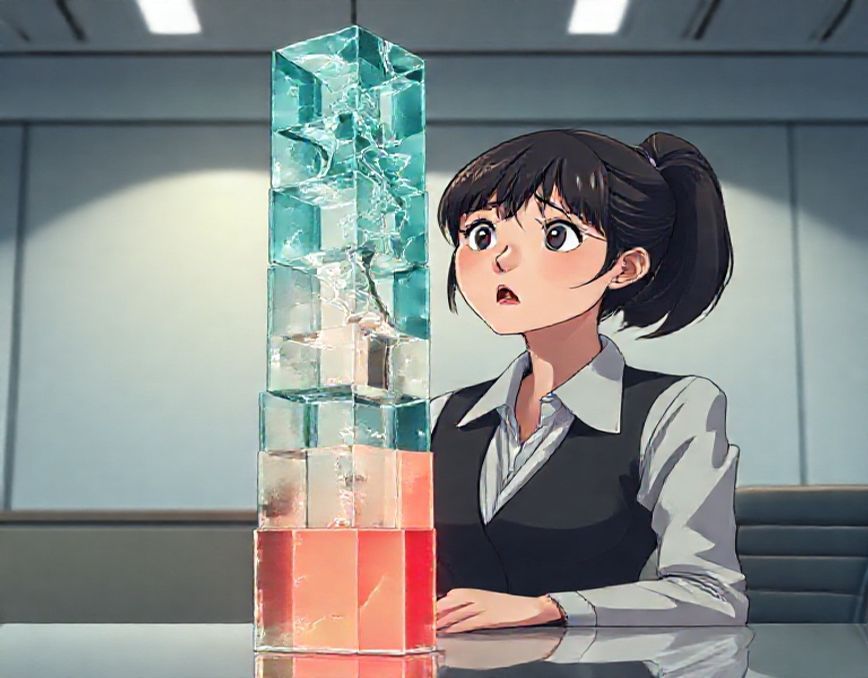
Decoding「盲点」: The Deadly 'Blind Spot' That Can Wreck Your Plans.
Decoding「盲点」(Mōten): The Deadly 'Blind Spot' That Can Wreck Your Plans
Have you ever been in a meeting where a seemingly perfect plan was being presented? Everyone is nodding in agreement, the air thick with confidence. Suddenly, the quietest colleague raises their hand and says one simple sentence:
「すみません、その可能性は盲点でしたね。」 (Excuse me, that possibility was a blind spot for us, wasn't it?)
A sudden silence falls over the room. A flaw, so basic yet unnoticed by anyone, is now glaringly obvious. The perfect plan suddenly feels fragile. This is the formidable power of 盲点 (mōten)—an incredibly common word in Japanese business and daily life that textbooks rarely explore in depth.
👁️ What Exactly Is a「盲点」?
Literally, 「盲点」is the blind spot in the human eye—the point where the optic nerve enters the retina, making it insensitive to light. Our brain is clever enough to 'fill in' this gap, so we don't even notice its existence.
In communication, the Japanese have brilliantly borrowed this metaphor to refer to:
A flaw, a risk, or a problem that should have been easy to see, but for some reason was completely overlooked.
It's not a complex error or an inherent weakness (弱点 - jakuten). It's a 'hole' in one's thinking, an 'obvious' trap you fall into simply because you were too focused on other things.
🤝 A Communication Tool for Reducing Conflict
The magic of 「盲点」 lies not just in its meaning, but in how it's used to maintain harmony (和 - wa).
Imagine that instead of saying 「それは大きな間違いです」(That's a big mistake), a phrase that sounds critical and assigns personal blame, a Japanese person would opt for the softer approach:
「そこが盲点でしたね。」(That part was a blind spot, wasn't it?)
This phrasing is brilliant because:
- It depersonalizes the mistake: It doesn't imply 'This is your fault.' Instead, it suggests this is an oversight that anyone on the team could have made. It turns a criticism into a collective discovery.
- It shows humility: When you're the one who made the mistake and someone points it out, admitting 「あ、そこは完全に盲点でした!ありがとうございます!」(Ah, that was a complete blind spot for me! Thank you!) shows you're receptive to feedback rather than defensive. It turns an embarrassing moment into a chance to display professionalism.
💡 How to Use It Like a Native
Let's see how 「盲点」can make communication smoother in real-life scenarios:
1. At Work:
- Situation: The team plans an outdoor event for a Sunday, completely forgetting it's a national holiday weekend and traffic will be a nightmare.
- Instead of saying: 「どうして交通渋滞を考えなかったんですか?」(Why didn't you consider the traffic jam?)
- Say this: 「ああ、連休中の交通渋滞は盲点でしたね。」(Ah, the traffic jam during the long weekend was a blind spot for us.) 🚗💨
2. In Daily Life:
- Situation: You buy a super cheap printer, only to find out its ink cartridges are incredibly expensive.
- You might say to yourself: 「本体の安さばかり見てたけど、インク代がこんなに高いとは…。維持費が盲点だった。」(I was only looking at the cheap price of the printer, I can't believe the ink is this expensive... The running cost was a real blind spot.) 🖨️💸
3. To Turn the Tide in a Debate:
- Situation: Someone is passionately defending their point. You notice a fundamental flaw in their logic.
- You could say: 「お話は非常によく理解できるのですが、一つ盲点があるように感じます。それは…」(I understand your point very well, but I feel there might be one blind spot. And that is...)
✨ Conclusion: See the 'Blind Spot' to Become More Nuanced
「盲点」is more than just a clever word; it embodies the Japanese approach to problem-solving: focus on systematically finding and fixing oversights rather than assigning blame.
When living and working in Japan, understanding and using this word will help you:
- Give feedback gracefully without causing offense.
- Acknowledge your own mistakes professionally.
- Demonstrate logical and deep thinking.
Next time you spot a hole in a plan—yours or someone else's—don't rush to criticize. Try smiling and saying, 「なるほど、そこは盲点でしたね。」(I see, that was a blind spot.) You'll find the conversation becomes far more constructive and effortless. ✨
Thẻ liên quan:
Lan tỏa kiến thức
Chia sẻ những điều hay ho với bạn bè