
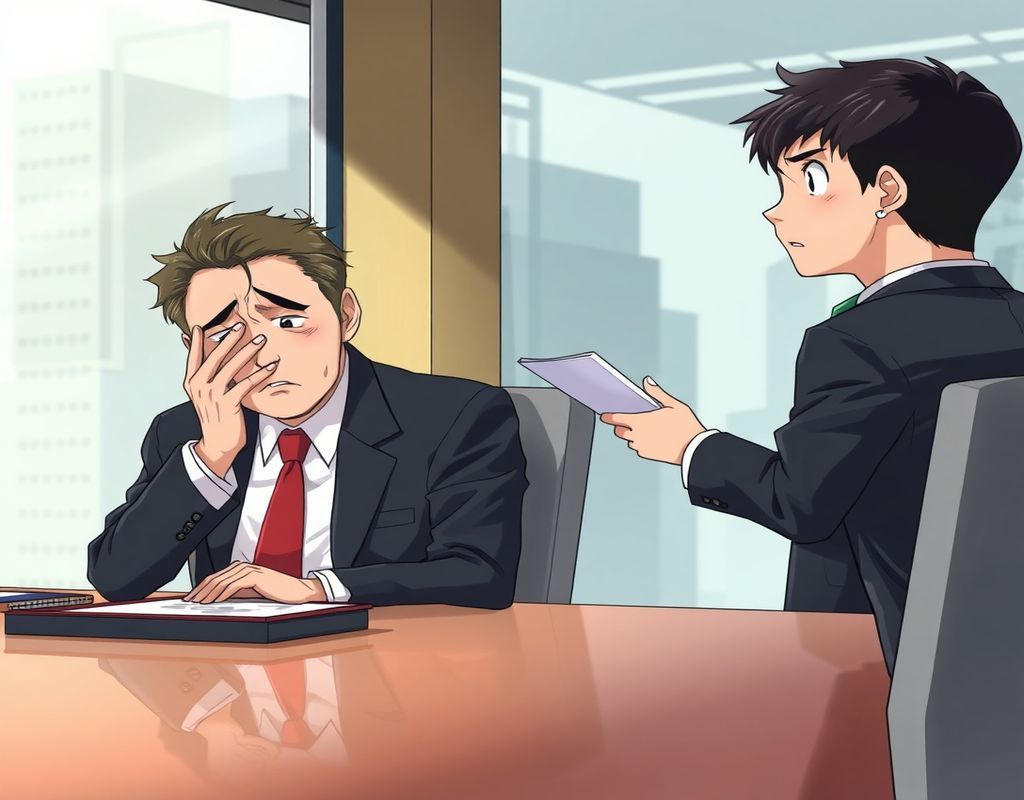
Decoding 「顔を潰す」: Avoid the ultimate social sin of making others lose face
Decoding 「顔を潰す」: When Making Someone 'Lose Face' Becomes a Social Death Sentence 🙅♂️
If you have lived in Japan long enough, you realize that "face" (Mentsu - 面子) is not just an abstract concept; it's a form of social currency. In previous posts, we discussed 「顔を出す」(making an appearance) and 「顔を立てる」(saving face). Today, I want to take you to the darker side of the spectrum: 「顔を潰す」(Kao wo tsubusu) — literally meaning to "crush someone's face."
In Western cultures, if you are wrong, I correct you immediately; that's called being direct. But in Japan, if you correct your boss or a partner in front of a third party, you aren't just helping them; you are "crushing their face." 😱
1. What exactly is 「顔を潰す」? 🤔
This idiom refers to the act of humiliating, discrediting, or making someone feel deeply embarrassed in public or within a group. When you "crush" someone's face, you are stripping away their right to be respected within that community.
In Japan, hierarchy and harmony (Wa - 和) are paramount. Once a face has been "crushed," restoring it is nearly impossible. It leaves a psychological scar and deep resentment that no amount of apologies can easily fix.
2. Common 「顔を潰す」 Traps for Foreigners 🚩
As foreigners, we often fall into these traps without even realizing it. See if any of these sound familiar:
- Correcting a superior during a meeting: The boss misquotes a number, and you immediately raise your hand: "Actually, sir, that number should be 150, not 100." Congratulations, you just crushed your boss's face in front of the entire staff. 📉
- Bypassing the chain of command: You have a great idea and report it directly to the CEO without consulting your immediate supervisor. This makes your supervisor look incompetent or out of the loop, effectively crushing their face.
- Public criticism: Criticizing a partner's food or a colleague's work performance in a group chat is a direct assault on their honor.
- Bluntly rejecting a referral: When someone introduces you to a contact or a job, rejecting it harshly without finesse embarrasses the person who acted as the bridge.
3. The Consequence: The Dreaded Silent Treatment 🤐
Japanese people rarely explode in anger when you embarrass them. Instead, they execute a "silent withdrawal." You might find yourself being slowly excluded from important projects, receiving fewer drinking invitations, and noticing that support from your colleagues has suddenly vanished.
In Japan, when you make someone lose face, you break an implicit rule of trust. They think: "If this person can embarrass me in front of others once, they will do it again." 🛑
4. The Art of "Face-Saving" (Kao wo tateru) 💡
So, how do you provide feedback without 「顔を潰す」? Here is the insider secret of long-term residents:
- The "After-Meeting" Rule: If you see the boss making a mistake, wait until the meeting is over. Catch them in the hallway or send a discreet message: "Sir, I think there might have been a slight confusion with the numbers; may I send you the updated version?" This gives them the chance to correct themselves later while maintaining their authority. ✅
- Use Questions Instead of Assertions: Instead of saying "You're wrong," try "Am I misunderstanding something? I recall it being..." This places the potential error on you, giving the other person a graceful way out.
- Honor the Middleman: If you were introduced by someone, even if you aren't interested, always start with: "Thank you to Mr. A for taking the time to introduce us..." Uplifting the middleman is how you protect their face.
5. Final Thoughts from a 10-Year Resident 🌿
Living in Japan for over a decade has taught me one thing: Technical skills might get you a job, but the skill of protecting other people's dignity is what gets you promoted. Never strive to be the "smartest person in the room" at the expense of someone else's self-esteem.
In Japanese communication, sometimes a well-timed silence or a private suggestion is worth more than a thousand blunt truths. Learn to protect the faces of those around you, and you will find your career path in Japan opening up like never before. ✨
Have you ever accidentally 「顔を潰す」 someone? Or have you been the victim? Share your stories with me!
Thẻ liên quan:
Lan tỏa kiến thức
Chia sẻ những điều hay ho với bạn bè